5. First Flight

  1. MY FIRST FLIGHT.
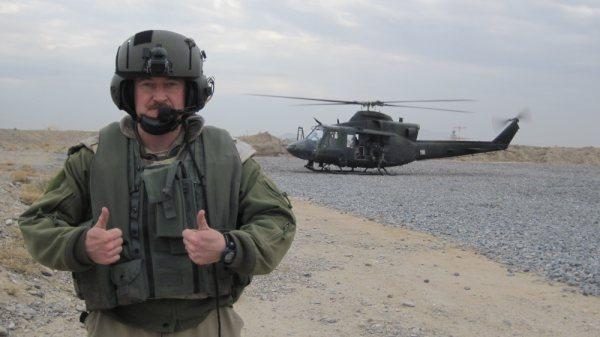
Steve after a pee
Thumbs Up!

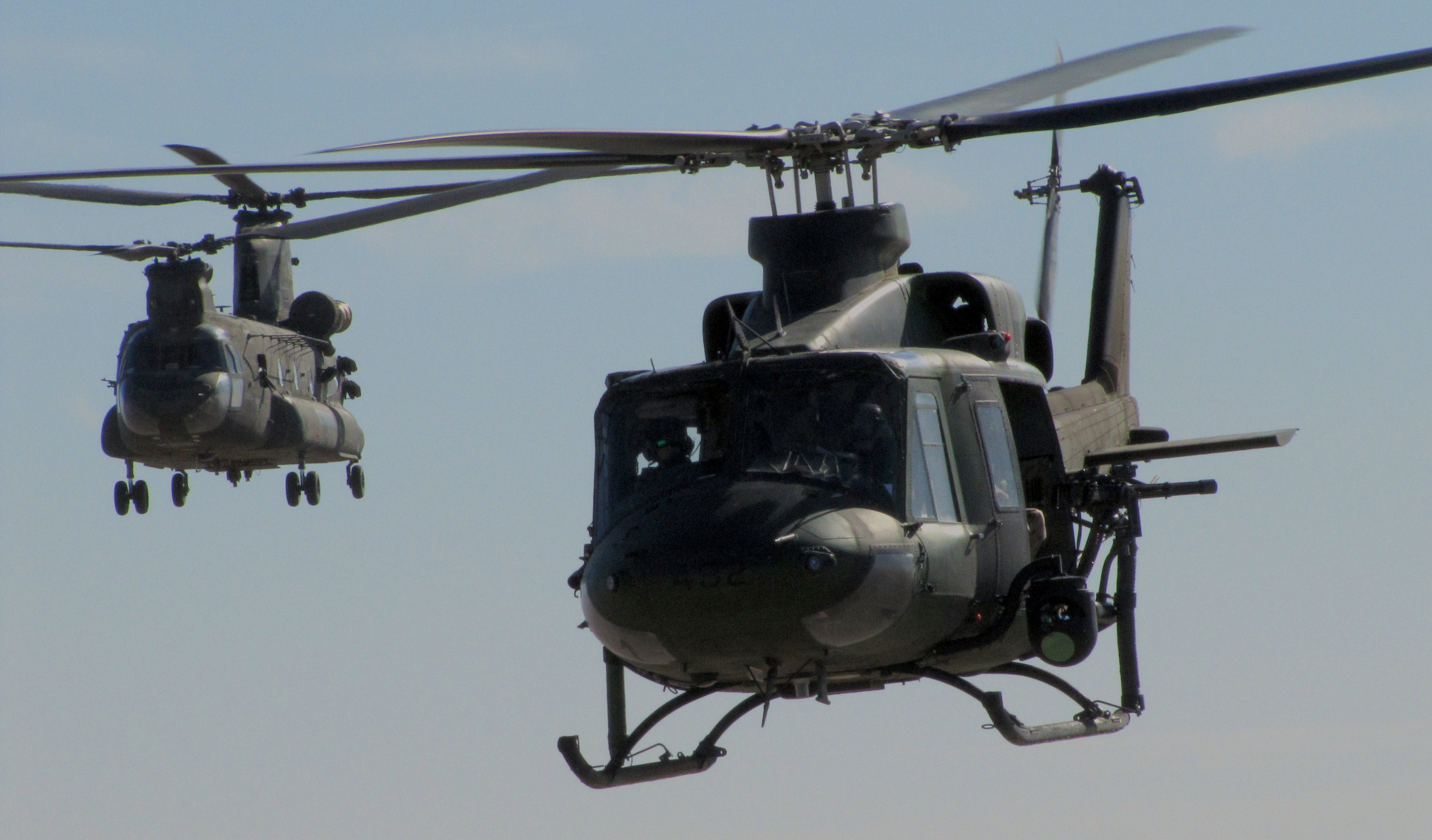
“BLOWTORCH 60 flight is clear to the north,” the radio cracked advising KAF tower that the section of two griffons and one chinook was proceeding outside of the control zone.

As part of my introductory flight, a Chinook was deployed to move some passengers. So my first flight in theatre was actually a mission day.

“Alright guys, let’s practice some tactical formation turns.” Chip announced over the radio.

“Tac Right!” the radio announced. The Chinook veered to the right sharply. This led to a sequence of three aircraft doing an organized ballet of twisting through the air. The sequences allowed the Chinook to avoid enemy fire while allowing the griffons to position for counter attack; all while maintaining formation defence integrity.

The chinook then completed some un-announced surprise turns. “Shakedowns shackle.” 26 called asking us to switch sides for better use of space and tactical integrity. I slid over over the the right side of the chinook while Grumpy avoided me and crossed under and behind to the left.

We twisted through the dessert sky east of Kandahar city for about 15 minutes practicing shackles and tactical turns until our rusty handling proficiency was back to normal after not flying for several weeks.

“Shakedowns, hate to break up all your fun but we have a task coming in, so time to go into Nathan Smith.” Blowtorch stated. It wasn’t uncommon for missions to come in once airbrone. Most missions happened that way. BLOWTORCH had to drop passengers and cargo into the city-central FOB called Nathan Smith. It named after one of the first Canadian soldiers killed in Afghanistan.
kandahar easbound with 134
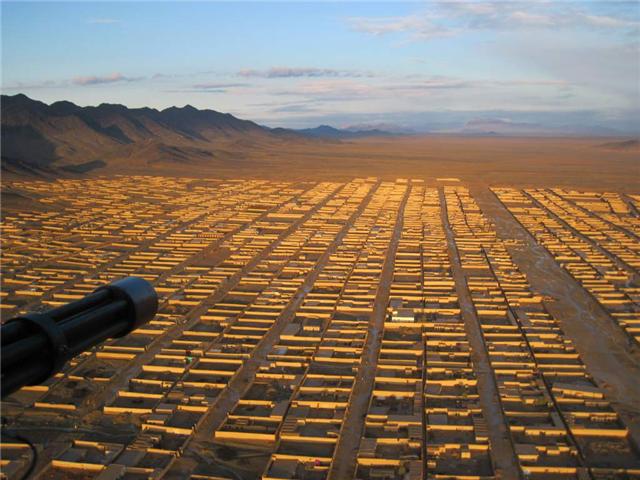
Kandahar City at sunset

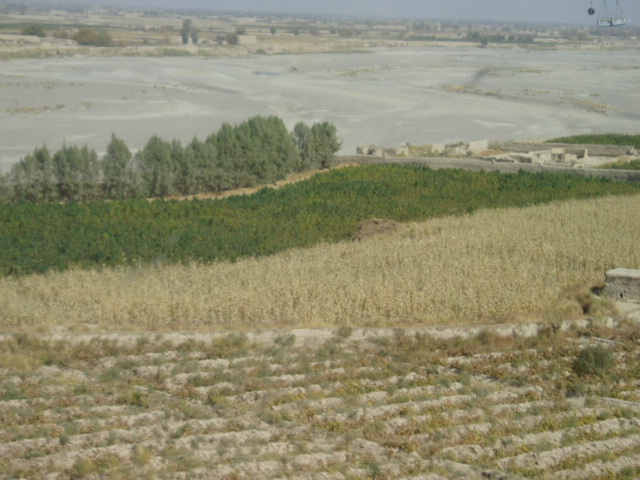
The scenery enroute was surreal. Brown ground, brown city and bright blue sky making for golden reflections off the mud walls in the city.  The city was massive but lacked tall buildings. The tallest and only colourful building was a bright blue domed mosque which was part of the religious university. The remainder of the city was a series of walls, which formed a labyrinth of homes, roads, canals and courtyards; all made of mud which hardened into concrete-like strength. Outside of the main city were smaller villages of compounds along the green zones. The Arghandhab river flows towards the south. Canals, hand-build, veered off the river, which irrigated the vast areas of grapes, watermelons, pomegranates as well as easily seen marijuana and opium poppy fields. All of this was brown due to the dusty summer season. The only green areas outside the waddis were acres of marijuana that were to be harvested in November.
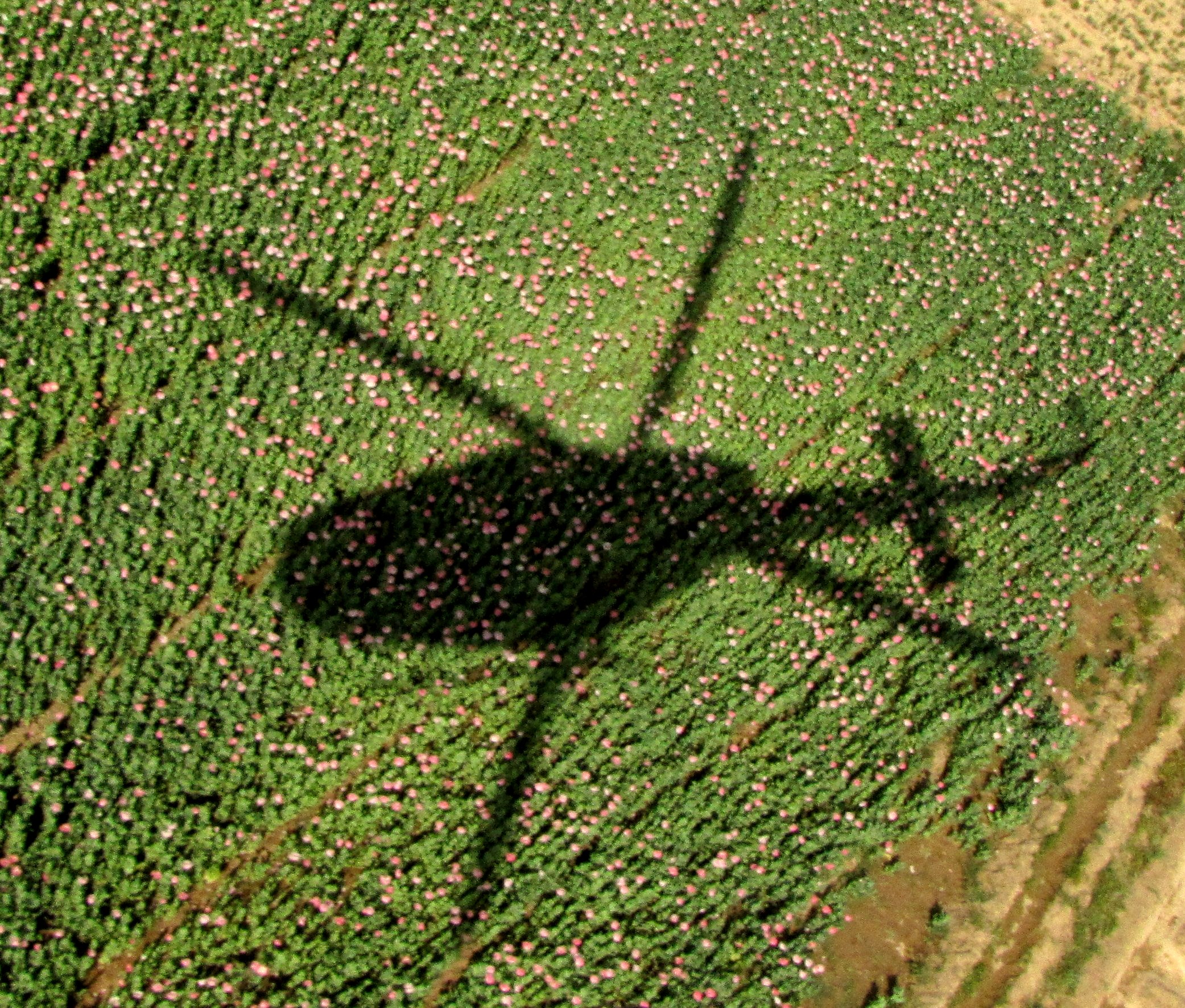
Poppy shadow
Griffon over opium poppies
OLYMPUS DIGITAL CAMERA
Bright green marijuana ripen for fall harvest.


“Inbound Nathan Smith.” BLOWTORCH advised us he was on final approach.
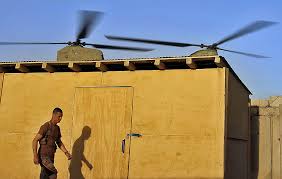
 

Chinook at CNS
Chinook in Nathan Smith
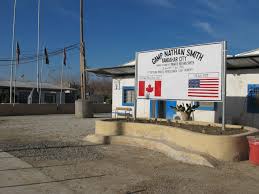
CN Smith
CNS

“Two-five checks,” Chip acknowledged. “Two-six you go cover high, we’ll take low. Deconflict at 700 feet.” He further instructed Grumpy. This allowed each griffon to individually maneuver. The top griffon was not allowed below 700’. In case we lost visual with each other, it was ceiling or floor to separate us.

There were numerous tactical methods that could be executed to conduct escort operations and overwatch protection. Sometimes the situation developed that would require a different protection style so it was worthwhile to do a quick radio confirmation. Sometimes the biggest threat was the risk of colliding with each other – easily preventable with simple communications and deconfliction plans.

Once the Chinook was on the ground,  the Griffon teams either climbed up to leave the area quiet to respect civilians around the FOB or operated in a distracting, aggressive manner to prevent Taliban from positioning for an attack. This depended on the briefed threat from Intelligence. Shakedown crews also looked for anything strange such as a dishka 51 calibre heavy machine guns, POL changes or rockets (RPG) teams maneuvering to ambush the chinook. In most cases, just enemy dickers were spotted. Dickers were Taliban positioned to report and/or strike if the conditions were favourable to attack the Chinook.
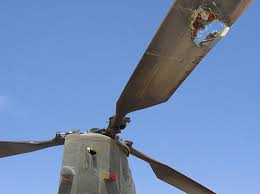
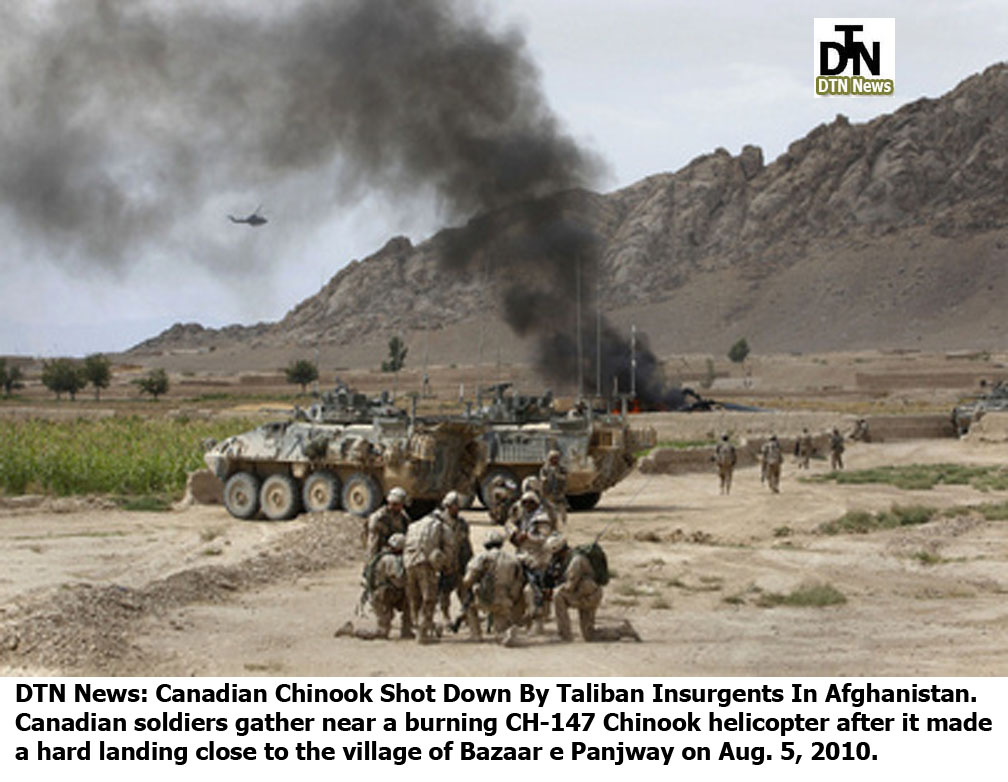
RPG hole in chinook blade
Example of chinook surviving an RPG attack.

Afghanistan Canadian CH-47 DTN News DTN Logos

Our griffon team tailed BLOWTORCH into the FOB checking the flanks for any dickers. I saw nothing peculiar; but then again everything was peculiar. I was so hyped up from training and anxious from the past two days of incidents that I could not tell the difference what was normal and what was not. It was a very overwhelming situation.

In training we became conditioned that people with shovels were digging IEDs. But now that we were there, I realized almost everyone had a shovel. They were filling in irrigation holes for the winter so the waters from the river could be trapped in the fields.  Additionally, a shovel over the shoulder looks remarkably similar to an RPG from a distance; and RPGs were not uncommon in the ANA (Afghan Army) or Police. So it became evident very soon to realize that an RPG (especially a shovel) was not necessarily a threat unless pointed at you. Everyone had weapons. The question then became what are they doing with them? Are they concealed or open? Are they shoulder slung or aimed? What is the behaviour of the person with the weapon?
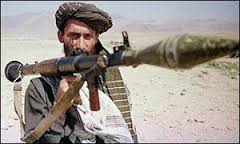
Taliban with RPG
RPG

As the chinook flared its speed to land at Camp Nathan Smith, Chip peeled off low level and flew around the FOB looking at anything suspicious outsie a quarter mile. Meanwhile, 26, with Grumpy, popped upto a much high altitude and observed the overall perspective. He maintained a position to protect us and maintain the potential energy to respond by diving in like a hawk, while concurrently being out of harms way to observe. Based on what he saw, he would call the Chinook and give the safest departure direction.

“Blowtorch lifting in 15 seconds southbound,” the BLOWTORCH 60 announced. 15 seconds gave us time to get quickly organized, assess the departure path and fly to arrive in a protective position as Blowtorch lifted away. When this was done well, the choreography would impress a crowd at an airshow. This ballet continued as we flew our griffons in behind Blowtorch as it cleared Nathan Smith’s walls; 26 diving in from above.

“That worked out better than expected. I guess you got a good demonstration on the first day.” Chip proudly stated admiring his smooth execution.

“Sweet.” I was impressed. We accelerated over the city at a low level escorting the chinook back to KAF. A short trip for BLOWTORCH today.

The radio sounded: “Blowtorch is clear to the south. Thanks, we can take it in solo guys, you can proceed with training.”

“Roger that.” Chip replied.

“25 this is 26, Ops cleared to the Reg for dustball and gunnery.” Grumpy announced from Shakedown 26’s radios. He was monitoring Freedom Operations frequency and I was monitoring Slayer’s air space. We then shared info on a common air-to-air chat frequency. The gunners from the Devil’s Infidel’s in the back of my helicopter vibrating with excitement hoping for a TIC every-time Slayer talked. However, there was no TIC for us yet.

“It’s good to be finished walkin’ the dog.” A voice stated over the intercom. It was a friendly rivalry between the two helicopter types. The Chinook could travel much higher and faster and often annoyed by our slow speed. Our retort to them bragging about speed was that we were “walking the dog.” It was just like having a big dumb dog on a leash constantly pulling us along; we always had to remind them to ‘heel’. Although formally it was stated as “Buster 10” over the radio; requesting them to slow down 10 knots.  Some Chinook crew took that insult personally. However, the statement proudly bonded the Shakedown crews.

“Absolutely, time to practice for TICs!” An eager voice replied. “Let’s go shoot some shit.”

I aimed our section south and as we approached the Reg desert, we broke into single ship training, 2 miles apart. The threat was minimal in the Reg for single ship training. If an insurgent wanted to take a shot at a helicopter, he would have no place to hide so it would be a suicide mission. Most people who take out helicopters are not suicide bombers. They are specialists wanting to collect a bounty and esteem – it is not a job for a martyr thus not much of a concern to us.
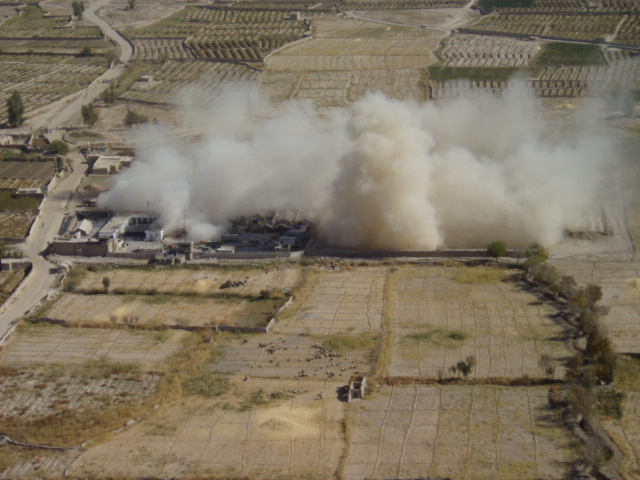
Typical dust explosion from brownout landing near Dand DC.

I lined the griffon with the landing spot and slowed my approach.

“On final approach.” I called.

The dust began to rise behind like a surfer’s tidal wave. It approached the cabin and the right gunner called: “dust ball by the door.”

About 2-3 feet above the ground the ball of dark brown talcum dust entirely engulfed the helicopter; the dust rushed in the open cabin doors, up under my visor burning my eyes forcing me to close one eye. I held the controls smoothly as Chip called the radar altimeter and ground speed:

“20 feet, 10 feet, 5 knots…cough, cough.” Pooof!

The sky darkened as the griffon grabbed the ground. The dust matured into a cloud about 300’ in height, it blocked the sunlight. This talcum powder was NOT like anything I had experienced before. I could barely see the pitot tube on the nose of the helicopter. We waited for the dust to clear enough to depart.

I coughed and rubbed my eyes. “I can’t see a fuckin’ thing.” I coughed again.

Chip wiped his chin and cleaned dust from his visor getting ready for the departure. “Many FOBs are still like this so we have to practice. You did okay, let’s get a few more in.”

I briefed the take-off plan to the crew. “Alright guys, Its clear right, moving up.” I called my actions.

“Clear left, gun ready,” the left gunner called.

“Clear right, gun ready, skids free, move up,” the right gunner called.

“Standing by.” Chip answered indicating he was ready on the controls in case I lost control and needed assistance. The dust thickened and swallowed the helicopter again. I held my breath and looked at the instruments and went vertically to clear the obstacles and pitched the controls forward. 5 seconds later, the helicopter re-entered clear air and a bright sky. I climbed and turned around to see a thick ball of dust that resembled an explosion. I exhaled forcefully clearing the dust from around my mouth. I was shocked by the difference between the dust balls between Arizona and Afghanistan. It was significant. Arizona was grainy, this was moon dust. I looked over a few miles and saw 26’s similar dust explosions that lingered in the still air.

“That was nuts — my eyes are burning!” I announced.

“Yup” Chipper coughed out clearing dirt from his mouth. “Let’s do some more – pfft pfft.” He answered while blowing the dirt out of his microphone indicating he was also suffering but used to it. The gunners wore full face shields resembling storm troopers from StarWars, on so the dust wasn’t as bad to them.
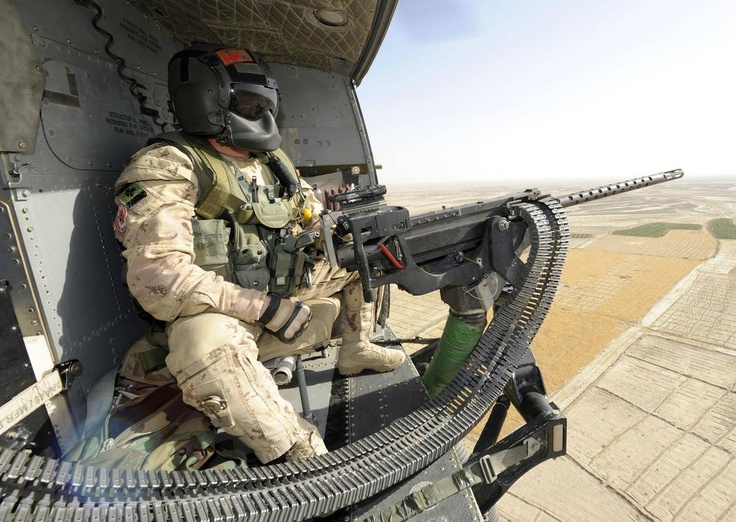
Canadian Gunner with a 50
Door gunner in mask – with a 50 cal.

We continued another twenty minutes taking turns at landing until our roles as the pilot flying and not-flying went smoothly. Once Chip was satisfied, he announced fun time:

“Shall we get some gunnery in?”

“Yes pulleese.” I hollered excitedly.

“Woo-yea!” The gunners responded. They finally got to have some fun shooting now that this ‘pilot shit’ was done.

“26, its 25. You ready for some gunnery?”

“That’s a big Romeo-Tango (Roger That),” 26 replied I could sense the smile behind the voice.

“Check that – We’re going to Texas Helo, call when your in position.” Chip commanded as the two-ship formation journeyed east to an isolated mountain where many of the coalition helicopter forces used as an aerial gunnery range.

I watched the other helicopter aim towards us from the right as we passed eastbound. He climbed and banked sharply over and behind us then drop into the left rear bout 100 meters away.

“26 is in.” Grumpy called indicating his helicopter had caught up and in tactical formation again.

“Steve, first thing we do is a fly-past to look for people. There are Bedouins living in the range, so we will just overfly a few times to make sure they get out of the way before we shoot.” Chip informed.
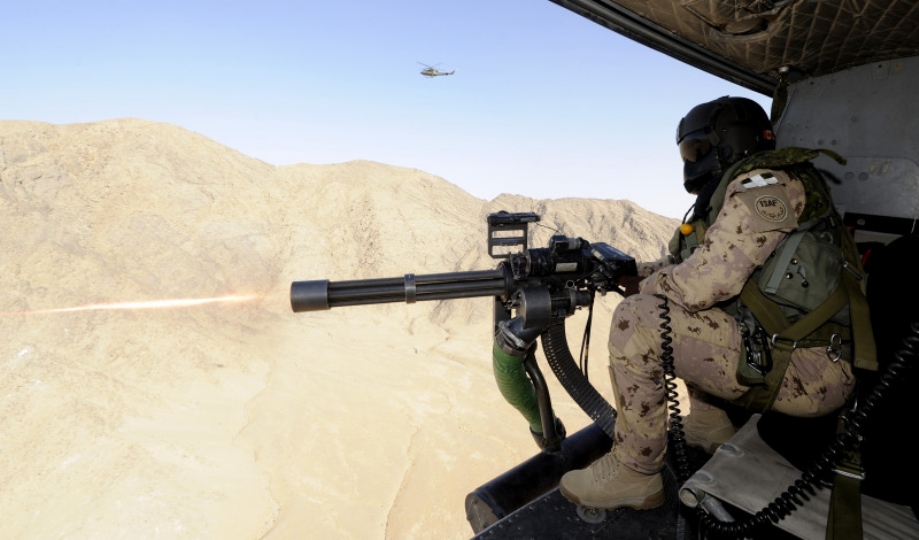
canadian at texas helo
Canadian Gunners at Texas Helo

“What are you talking about, people live there?” I was perplexed.

Chip pointed to the ridge of mountains oriented southward. There was a deep cut from the sand edge of the dessert easily three hundred feet deep and two-hundred meters wide. At the lip when the sand wall levels out, the dessert continues for over a hundred miles west and fifty miles south to Pakistan. Often caravans of camels or vehicles could be seen slowly migrating across the rolling sandy hills just to the west side of Texas Helo.

“Over there, on the west floor are Bedouin tents.” He pointed. “They come out and collect the brass casings after we shoot – They sell it back to us at the KAF market in the art form of brass camel sculptures and stuff.” Chip added.
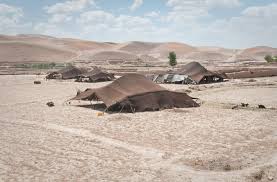
Bedioun Camps
Example of Bedouin Camps similar to those at Texas Helo.

I was astonished. These groups of tents had been set up for several years. Women and children (WACs) were playing amongst the tents but they moved out of the way as we circled. It was a brass collection tribe. The hot brass casings from the helicopter machine guns would naturally fall quite close to them; if not on them at times. Bedouin children will playfully wrestle over collecting them as we fired thousands of rounds from directly above. The brass was sold to artisan merchants. These casings were often turned into brass plates, statues and other artifacts – and strangely enough, resold to soldiers at the KAF open-market on Saturdays.

“Area Clear. Bedouins clear – Target Brief. Target is the red boulder, 1 o’clock 1 km, marked by lead’s rounds. This will be a single pass, 1 plus 1, right gun attack, 200 meters, 200 feet high, All effects East.” Chip gave the fire orders over the radio.

“26, visual friendlies, tally target, check brief,” a happy tone responded from Grumpy’s radio.

Chipper continued internally: “Right gunner, copy brief and target?”

“Roger dat sir, tally target, standing by,” the FE Gunner acknowledged mechanically.

Chipper steered the aircraft to about 200 meters left of the targets and about 200 feet above the valley floor. As we approached the target, he commanded:

“Right gunner, are visual with 26 and the Bedouins?” Chip asked.

“Roger.” It was a last chance check just to note where the closest friendlies were in order to ensure no one got hurt other than the targeted red rock rapidly approaching.

“Cleared to Fire.” He commanded

Up until that point, the only weapons I had commanded was the C6 (M240). I knew it wasn’t going to be the ‘chug-chug-chug’ that I was accustomed to, but I never expected this. The initial noise spike painfully penetrated my skull.

BRAAAAAAAAAP….BRAAAAAP…BRAAAAAAAAAAAAAAAP.

Fifty rounds per second of 7.62 mm tracer volleyed off the painted rock target. It was a lava flow of light and a piercing noise so loud it overcame any cockpit communications. The smoke from the rotating barrels spooled out beside my head and filled through my cockpit window. The gunner stopped every 3-4 seconds for a quick communication break. If no one was yelling “check fire” then he continued blasting at the target. Out the left, young Bedouins were running towards the falling casings, fighting each other along the way. I looked right and saw splashes of ricochets from 26 joining our stream of bullets.

“Out of arcs.” The gunner stated checking his fire. This advised the pilot that he couldn’t accurately or safely shoot anymore and it was upto us to adjust or escape. At times he may yell “kick right or left” to twist the griffon in the air allowing for continued firing time.

“Same attack, left gun south to north.” He commanded to 26.

“Roger that.” Grumpy acknowledged from 26.

“You have better view, you have control Steve!” Chip stated.

I turned around to re-align on the target for the left gunner to fire. I aimed the helicopter just left of the Bedouins to not drop casings directly on them.

“Left gunner, Bedouins WACs right, same target, Fire!” I called.

“Visual WACs, tally target!” he replied.

BRAAAAAAAAAAAAP

“Out of arcs. Weapon safe.” Called left gunner as we passed.

“After this pass, we quit.” Chip advised over the radio. “The Bedouin WACs are too close now, they’re gonna take a ricochet. Let’s go to the Reg to finish up.” Chip made a safety call.
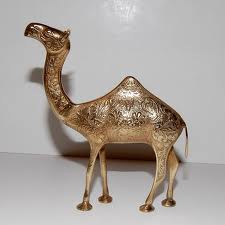
brass camel
Bedouin Brass Art – former shell casings

We proceeded out to the middle of the dessert to continue shooting; near an old dead lake bed where the sand was smooth.

“For fun, we’re gonna do a double gun, full forward fire to show you — just cause it’s cool.” He smirked. “Now keep your hands inside the window or they’ll get sawed off!” He grinned but was serious. If I stretched my arm out the open window it would be sawed off at the elbow in less than a second. With that in mind, I slouched and dipped my body behind my small armour plate on the left of my seat. Chip noticed and shook his head smiling at my expense.

We overflew the target. A piece of brush easily identifiable to both aircraft.

“Target brief, Reference east west lying Lake bed 2 km south?” He directed to 26.

“Contact lake.” the quick answer.

“Centre of lake south side is a prominent bush.” Chip further described.

“Contact bush.” Grumpy answered.

“That is the target.” Chip stated.

“Tallllleeee  target.” Grumpy sang triumphantly.

“Dive attack from 500 feet, left egress!” Chip called over the radio.

“Roger that!” the acknowledgement.

We raced across the dessert floor at maximum speed and pitched up aggressively to 500’. 26 was 800 meters behind. Then dove towards the target re-accelerating.

“Gunners do you have the target?”

“Roger that sir.” They both replied.

“Left-right gunners….Fire!”

The sound was deafening beside my head. Chip flew directly at the target and wiggled the peddles left and right steering the bullets across the target. The dessert floor exploded into a dust cloud with splashes of tracers occasionally bouncing off small rocks. I squeezed my helmet tighter to eliminate some of the noise.

He turned left hard at 200 meters away. The left gunner stopped firing but the right gunner continued suppressing until 26’s bullet stream matched his before stopping.

All I could smell was cordite and my ears rung.

“That’s bloody nuts!” I yelled totally overwhelmed with the smoke, fire, noise and dive-attack! “But so cool!” I couldn’t help but smile as I wiggled my jaws trying to clear the ringing in my ears.

“Ha-ha-ha” Chipper was laughing proudly. The other guys followed.

“Woo hoo, yee ha. Fuckin’-A!” the heavy French accent gleefully cheered from the back left.

“That’s why the Taliban call it the breath of Allah!” the FE on the right proclaimed. He laughed. “Are you okay up there Steve?” he asked mockingly. I smiled. I knew they were laughing at my shock.

“Dat’s why dey call us za Devil’s Infidels!” the left gunner proudly stated referring to the enemy’s description of them.

“It’s getting dark soon.” 26 advised over the radio. His smile could be heard through his voice.

“Roger that, let’s go to the FARP and head home.” Chip agreed as he directed me with his arm pointing in the direction to fly.

The FARP means Fuel and Ammo Replenishment. All the helicopters stopped and fuelled with the engines running so they could be ready for the next mission immediately without shutting down.
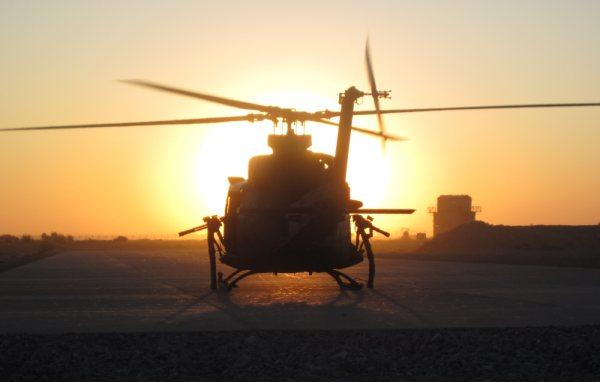
FARP at sunset
Near KAF FARP.

“You can lead us back, we’ll take number 2 and get some formation practice.” Chip advised to Grumpy in the other helicopter.

“Roger.”

It was my turn to fly protection. I slipped in behind Grumpy and practiced maneuvering to cover lead to KAF. It was quite an orientation so far. The sun was setting in the west and the sky was a bright rusty-orange. It was beautiful considering the lifelessness. Yet, with such a hostile environment, there were villages and Bedouin towns every few miles all throughout the desert. The people here were rugged and able to make life survivable despite the harshness.

“Let’s grab some gas, food and brief. We have a mission later transfer tonight and we’ll do the familiarization again, but on NVG.” Chip concluded and briefed to all over the radio.

“Roger that. 26 out.” Grumpy responded.
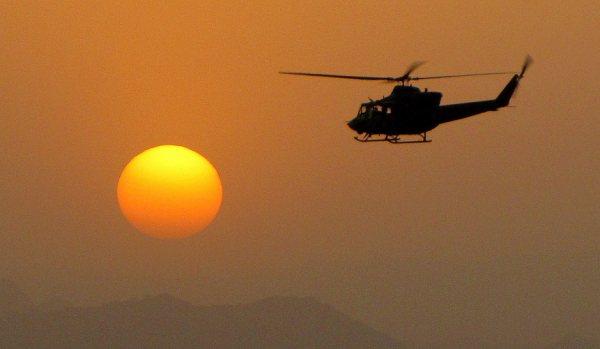
griffon jelwar sunset three
Dusty Sunset

“Shakedown 25, this is Freedom Ops, over…” the Squadron TOC was calling.

“Go for Shakedown 25.” I replied.

“Gas up and top your ammo, Pax at X-ray for GRACELAND are ready.” He informed us of our new tasking. As what would become normal, a mission came in while we were airborne. My night orientation was just turned into a mission as well…with Special Forces.
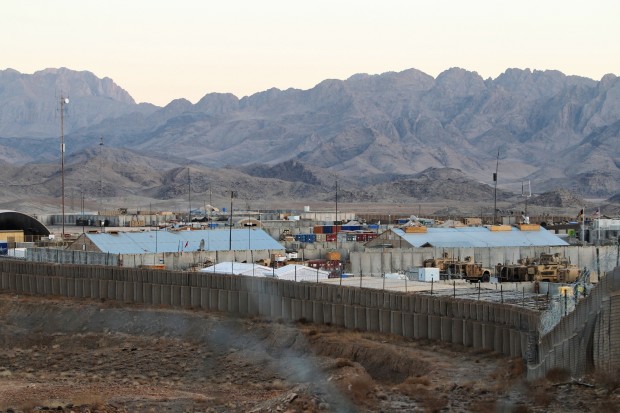
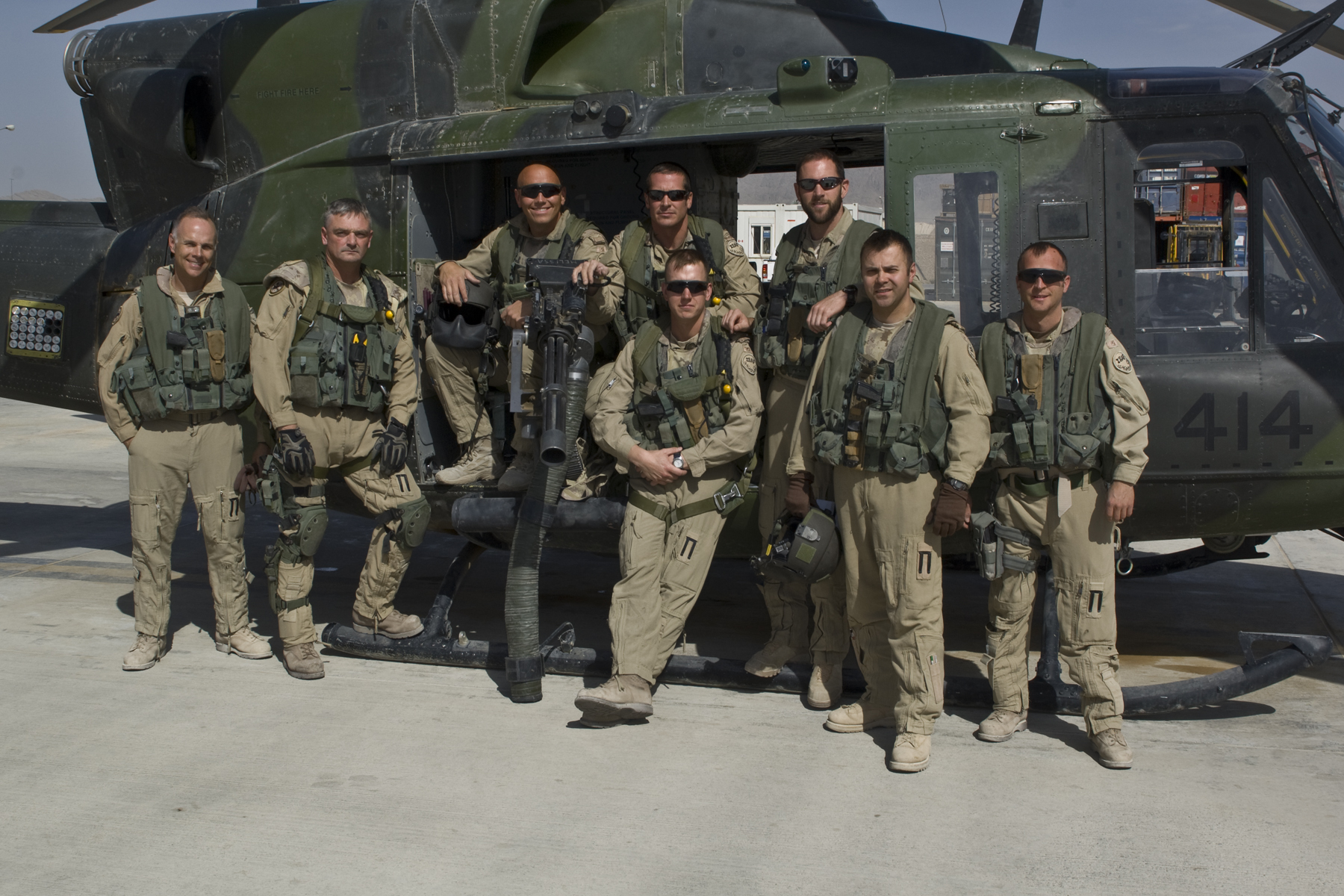
Guest Blogger: Bullets Above – Airborne Battle Damage: by Greg Juurlink.

This is an amazing story from Greg. I served with Greg in Afghanistan. He is an insightful professional airman and always had an upbeat perspective. He was key in maintaining the esprit de corps in our unit and I am proud to know him and share his memoire. You can read his story and see more pictures through this website:    http://www.afghanistanacanadianstory.ca

To Greg, I remember this well. The radios were alive about you and 3 Section. I was airborne with Section Two returning from QALAT the same time you were hobbling into FRONTENAC. Operations was very excited. I’m sure the Ops O was kicking shins to get things organized.

Additionally, I remember a few quotes and facial expressions that will be eventually mentioned. Glad you made it through the Devil’s Belly Button. Great read Greg. Thanks. And thanks to the producers of that website. Steve

Frontenac
FOB Frontenac looking south…20 minute flight north of KAF

Bullets Above – Airborne Battle Damage 

By Captain Greg Juurlink, Op Athena Roto 8 CHF(A) Griffon Pilot. (October 2009 – August 2010)

Canadian Helicopter Force Afghanistan [CHF(A)] was established at Kandahar Airfield on 6 December 2008, and reached full operational capability in May 2009.  The force, equipped with eight CH146B Griffons and six CH147D Chinooks, was activated to provide Canada and the International Security Assistance Force (ISAF) with enhanced aviation support in southern Afghanistan.  A typical Griffon Weapons Team (GWT) was made up of two Griffons modified for operations in Afghanistan and equipped with a combination of M-134 (7.62 mm) mini-guns or GAU-21s (.50 Cal) and an advanced MX-15 optical sensor.  GWT’s were employed in reconnaissance, utility transport, and Chinook escort.

The Griffon fleet also flew Close Combat Attack (CCA) missions providing overwatch and fire support for Canadian and Coalition Force troops on the ground. The Chinooks, acquired from the 101st Combat Aviation Brigade, were equipped with M-134 mini-guns and M-240 machine guns and were employed in the transport of troops, equipment and supplies as well as air mobile ground assaults. Before standing down in August 2011, the CHF(A) fleet moved 91,608 passengers and 7,111,504 pounds of cargo while logging 23,428 combat hours. CHF(A) was made up primarily of 1 Wing members from 400, 403, 408, 427, 430, & 438 squadrons, and was complimented with personal from all wings and numerous army units from across Canada. Throughout its period of operations, CHF(A) established an enviable record of flexibility and reliability in the full rage of combat aviation

After arriving in Afghanistan in October 2009, I began work as a CH146B Griffon line pilot in 3 Section, made up of 2 GWTs. An ex-Infantry platoon commander from St. Andrews (Antigonish), Nova Scotia, I occupied the First Officer position in the lead aircraft.  Our section commander was affectionately known as “Uncle Ron” from Edmonton Alberta, was a seasoned pilot and a veteran of Haiti, Bosnia and a ground tour of Afghanistan in 2007.  He had all the answers, was easy to work with and to follow into combat.  Our crew also included Alex from Trois-Rivieres, Quebec.  An ex-armoured soldier with a previous deployment to Bosnia, Alex turned aircraft mechanic and eventually applied for and became a Flight Engineer (FE) on the Griffon.  FE’s are the aircraft systems experts who ensure the helo is good to fly, and can fix it if and when required.  They also doubled as door gunners once airborne.  Finally Luke, from Emo, Ontario, rounded out our crew.  A member of the Princess Patricia’s Canadian Light Infantry (PPCLI), he was our left side door gunner and our expert on the aircraft weapons systems.

Our #2 aircraft was commanded by Ottawa native Dwayne, an Ex Navigator turned pilot.  From West Vancouver, his First Officer was Christian, a Search and Rescue pilot posted to 417 sqn in Cold Lake; Vic from Sayward (Kelsey Bay), BC, an ex army soldier was the FE and right side door gunner; and, PPCLI Sgt Chris from St. Johns, NL was the left side Door Gunner.  3S4L!

Our Roto was mostly crewed by Edmonton based 408 Squadron but was complimented by numerous augmentees; myself and seasoned instructor pilot “Smitty” from 403 Sqn in Gagetown, NB.  Smitty was my mentor, but also someone I joked around with.  On Halloween I shaved my beard off, cut my hair short and took a razor to the very top of my head for that extra bald look, so that I could look just like him.  I then snuck into his bunk at night and borrowed his velcro name tag. I put his nametag on my flight suit and presto, I was Smitty for Halloween. These lighthearted moments helped distract us from the war during our downtime.

English/Anglais AR2010-0075-06 06 April 2010 Kandahar Airfield, Afghanistan. Joint Task Force Afghanistan (JTF-Afg) Griffon Flight from Kandahar Airfield. JTF-Afg is Canada’s military contribution to Afghanistan. Canadian operations focus on working with Afghan authorities to improve security, governance, and economic development in the country. Cpl Owen W. Budge, Joint Task Force Kandahar Image Tech, Afghanistan Roto 8.
Three Section.

Just shy of a 10-month deployment, I ended up with 103 missions and almost 600 hours flying.  You could only get 1 mission per day and it had to be for a combat mission rather than maintenance test flying.  We had a number of missions including moving troops around the battlefield supporting special operations forces, and protecting the Chinooks.  We were also called upon to support TICs (Troops In Contact) by performing Close Combat Attack (CCA) to end firefights quickly and decisively.  We patrolled roads by day and night to find Improvised Explosive Devices (IEDs) or Taliban fighters setting them up, eliminating the Taliban when required.  We also did utility transport, which involved moving a couple soldiers or snipers at a time to strategic locations. What made my job enjoyable was the variety of missions we were called upon to perform.

The mission I’m about to talk about is one I’m sure I’ll never forget.  This was the only mission we were unable to complete.

The date was November 24th, 2009.  I was gearing up for my 9th combat mission.  We arrived at work early that day for planning.  The weather was rainy which kept me up at night because I was sleeping in a tent.  Our mission was to go to the Dutch FOB of Tarin Kowt to pick up some passengers, then to Nili (Day Kundi), and on to FOB Anaconda to move passengers and cargo.  Our role as a GWT was to escort and protect the Chinook.  Our route was through a mountain pass, which was not ideal as our altitude was limited by low cloud cover.  This prevented us from flying high enough to be out of range from small arms fire.  In Afghanistan we were unable to fly in cloud due to the lack of instruments, which allow us to do so as they were removed to reduce weight.  Most of the mountains were too high even if we had the equipment.

It was our standard 3 section crewing for that mission, led by our Deputy Commanding Officer (DCO), another experienced aviator.  His crew included co-pilot Jon, Door Gunner Edward, and Flight Engineers Hodder and Miguel.  As we prepared to launch, our biggest concern was the weather.  Rain, reduced visibilities, blowing dust and thunderstorms were forecast. A Satellite (SAT) phone call was made to Nili to confirm the conditions.  They were reported as acceptable therefore the decision was made to launch after our intelligence brief given in order to assess, where the biggest threats were located.  The plan was to proceed to Tarin Kowt and re-assess.  If at any time the weather looked marginal, it was agreed we would turn around and return to base (RTB).  Our call sign that day was Shakedown 25 (SD 25) and our number 2 was Shakedown 26 (SD 26).  After we started we flew to the FARP or Forward Arming and Refueling Point, to top up our fuel.  We then learned that the Chinook, call sign Blowtorch 60 (BT 60) was unable to fly the mission due to a mechanical problem.  We returned to the ramp and shutdown while BT 60 changed helicopters.  During this delay another weather check was conducted and FOB Nili was dropped off the mission due to deteriorating conditions.

The decision was made to carry out the rest of the mission and the formation departed low level, east of Kandahar city.  We test fired our guns and then transitioned above the range of small arms.  Once at altitude, Ron started coordinating airspace while other crews did their assigned tasks including navigation and coordinating with our headquarters (HQ).

I was flying at the 7 o’clock position of the Chinook, SD 26 was on the right.  I usually fly further to the left of the Chinook but as we were flying up a valley I thought the further away from the mountain on our left, the better.  I was looking at the overcast cloud layer, which seemed to be higher.  The mountain peak on our left was covered in cloud.  The view was beautiful as most views of Afghanistan from the air often were.  It was at this time I noticed our Radar Altimeter, which tells us our height above ground, was alive meaning we were in the range of small arms.  I then commenced a climb.  The Chinook also started climbing as we both realized the valley we were flying up was steadily getting higher and closer to the height we were flying.  Classic rising terrain.

Seconds after starting that climb, I heard a very loud bang followed by white smoke in the cockpit coupled with numerous electrical failures.  This was my first airborne emergency in the Griffon.  Electrical fire was my first thought.  At the same time our #2 Generator fell off line causing us to lose our secure comms and the ability to talk to each other due to an enormous amount of static coming through our headsets.  As I was acknowledging the helo being on fire and executing the emergency procedure for it, I heard Alex call “BREAK RIGHT, BREAK RIGHT!!”  Just then, Luke saw numerous rounds pass about 5-6 feet in front of him on the left just prior to the break.  The bullets left contrails behind them due to the moisture in the air and changes in air pressure caused by the passing bullet.

I then began to turn and started heading down to the low level environment to evade the threat.  I was flying evasive maneuvers and looking for a place we could safely land and egress a burning helicopter.  As I’m turning I felt Ron on the controls.  Normally, to transfer controls the Pilot Monitoring (PM) would say “I have control” to which The Pilot Flying (PF) would relinquish control and say “you have control.”  This is hard to do and confirm when you can’t talk or hear each other.  When this is the case it’s done by the PM grabbing and wiggling the controls.  When I broke right and started heading for the ground I felt Ron on the controls, which to me, a new FO, meant he wanted to fly.  I then let go of the controls and put my head down in to see our Computer Display Unit (CDU) and started working the radios to clear the static.  That’s when I noticed Ron with his head down working the radios as well.  Luckily, I was flying with a level of automation engaged so the helicopter was doing exactly what I left it doing when I let go of the controls.  After a few seconds with no one flying the helicopter I picked up my head and continued flying.  Ron sorted the radios and got a Mayday call out to the formation as I did a systems check to see what our problems were.

Luke and Alex were very busy looking for the enemy position or point of origin where the rounds came from in order to return fire and eliminate the threat.  There was still a Chinook and another Griffon who were targets themselves and possibly unaware of the immediate threat so we still had to do our job and protect them.  No one at war likes getting shot at.  It’s worse and frustrating when you can’t shoot back, especially when you’re armed with M-134 mini guns capable of firing 50 bullets per second and have a few thousand rounds on board.  We never did find the enemy or fire a round that day.

After a systems check, I noticed the smoke had stopped and the smell of burning wires was never-present.  Still not sure where the smoke was from, I was sure we were no longer on fire.  I figured it out later that we were never on fire at all.  I was once told that every time we would send a helicopter back to Canada for a full inspection on a maintenance rotation (we had 12 Griffons allocated for Afghanistan, 8 on the line and 4 being rotated for full inspections back in Canada), it would come back 300 pounds lighter from removing the dust that would accumulate in them.  Anyone who’s been to Afghanistan knows the dust I’m talking about, that fine, white, flour like dust which interestingly enough, looks just like electrical fire smoke when stirred up by a bullet entering an air data computer in a Griffon helicopter.

At this time, Ron had fixed the radios and was communicating with our formation.  The Chinook went high level to avoid the threat while our section team mates SD 26 got on our 6 O’Clock to protect our decent and egress.  Before we arrived at the spot I chose to land we decided as a crew to carry on low level to a Forward Operating Base (FOB) 19 km away hoping the helicopter would make it.  Our other option was to land, which would most likely lead to the loss of the aircraft or even worse, to a fire fight on the ground with the Taliban.  That’s nothing a 4-man helicopter crew ever wants to do.  The Taliban always seemed to appear out of thin air, even in the middle of the desert sometimes.

The main concern now, was if we had taken rounds in the tail rotor.

If it had, the rotor could come off anytime.  The Griffon was designed for delivering oil workers to off shore oil platforms, not combat.  If the tail had come off it’s unlikely I’d be writing this today.  We lost a Griffon in July of 2002 in Labrador due to a loss of its tail rotor.  2 Pilots were killed and this was definitely on my mind.  The aircraft felt fine, so we pressed on.  This was the worst part of the whole event.  Everything else happened so quickly there was no time to think about it, only react.  Now that we were low level away from the threat we had time to think about all the problems we might have like tail rotor, hydraulics, fuel, and so on.  We considered pretty much any problem we could have.  To make it worse, we could only do a limited Battle Damage Assessment (BDA) while airborne, so we were unsure the extent of the problems.  After about 10 minutes we arrived at the FOB.  I’ve never been so happy to see one in my life.

After shut down SD26 and BT60 landed to assist us.  We did a battle damage inspection and found damage to a main rotor blade where a bullet had passed through it and a bullet into the air data computer, inches from my left leg.  We then stripped our guns and equipment off the helo and loaded it on the Chinook.  As the crew did this I went to the Operations centre of the FOB and talked to the Officer In Charge (OIC).  I told him we had a helicopter full of bullets on his HLS.  He then asked me if we wanted “a download” which means to take all the ammo off the helicopter.  This procedure is common for attack helicopters.  I then had to explain to him they were “bad guy bullets” and the helicopter had to be left there until a team of maintainers could come out to fix it.

We then got on the Chinook for the long ride home.  It felt like a ride of shame as we left our helicopter (CH146458) in the FOB and had to rely on our Chinook brothers to take us home.  Since we began Helicopter Ops in Afghanistan we always had friendly banter between Chinook and Griffon crews on which job was better and more important.  The Chinook role was more important in the end.  They moved so many troops and supplies and could be escorted by other Attack helicopters.  The problem was that there simply weren’t enough attack helicopters in theatre.  Enter the Griffon.  With that said I would rather fly the Griffon there any day.  It’s better to be a shooter than a target in my mind.  At the end of the day we’re all one team, but we did take a bit of a ribbing that day.  I did get my first ride on a Chinook, one of the most prolific combat helicopters ever built.  Our Chinooks ended up moving over 91,000 troops and 7 million pounds of cargo in it’s 3 year deployment.  In fact, no other country’s stats even came close to what Canada was moving.  I spent numerous days flying over 8 hours.  My max was a 10.2 hour mission in which the Chinook we were escorting flew a 10.7.  We had 0.5 less because we had to shut down in Helmand province for fuel while the Chinook took their fuel while running.  To put it in perspective, I fly about 2.5 hours a day in Canada.  We got a letter from an Army commander thanking us for our support as his whole deployment from start to finish was moved to and from the FOB’s they operated from by helicopter.  We were proud of this accomplishment as 80% of casualties were from IEDs.  Moving by helicopter was much safer than moving by road.

The Chinook is built for battle. In fact, the very Chinook we flew home on and were escorting that day also took a round in an empty fuel tank.  The crew heard a thud but thought an ammo can fell over.  The bullet entered the fuel tank and ignited the fumes causing an explosion that buckled the airframe causing major damage.  The machine is so tough the crew couldn’t even tell until they shut down back at Kandahar Air Field.  The Chinook required major repairs and was out of the fight for weeks.

As for the Griffon we were flying, we sent a crew to FOB Frontenac, north of Kandahar, to patch it up to get it back to KAF.  They did a full inspection that showed 50 wires were damaged and 30 were cut clean off.  They replaced a blade and had to jerry-rig some wires to “hot wire” the number 2 engine starter to fly it home.  It took a week to get it home.  It then took another 6 weeks to re-wire the whole helo to get it back in the fight.  CH146458 is currently flying at my home unit 403 Squadron in Gagetown, NB where I teach new pilots how to fly the same machine I fought with in Afghanistan.  It’s a nice full circle.

An intelligence update after our mission showed that 2 Chinooks were shot down in the same location in 2007.  2 weeks after our mission, a Dutch Cougar helicopter received extensive damage in the same location and did pretty much what we did recovering in FOB Frontenac.  The damage was so excessive a MI-26 had to sling the helicopter back to KAF.  Their Hydraulics failed in a 4-foot hover.

The FE on the Chinook had a helmet camera on the tail of the Chinook when we got shot.  It’s amazing the amount of bullets fired at the Chinook and us that day from and enemy machine gun.  You can hear each one in the video.  We were very lucky we only took a few rounds and got away.  Throughout the tour I saw many videos in which you could hear bullets flying by.  It’s hard to say how often we got shot at.  Between videos and ground force reports it seemed pretty regularly.  Luckily, I never got hit again.

The men and women of CHF(A) were top notch and I wouldn’t want to go to war with anyone else except possibly the men and women who were on the ground.  We all have countless stories of seeing our ground forces take it to the enemy fighting through great adversity.  As combat aviators it was our job to be there for them.  I have many stories in which we reacted to the enemy engaging friendly forces.  Each time we were able to intervene and provide fire support from above to end fire fights.  All too often we were called to provide assistance to ground forces after IED attacks and had to bear witness to the destruction the Taliban were capable of.  Our mission was very intense, seeing 21 of our fellow soldiers fall in combat.  It was tough to deal with and underlined the importance of minimizing the threat to our troops by moving them by air.  Occasionally, we also got to patrol the roads at night looking for IED’s or Taliban placing them helping ensure the roads were safe in the morning by either advising ground troops of the IED location or by eliminating the threat ourselves.  I doubt I will ever do anything nearly as rewarding again in my life.

Thanks again for this Greg. For Freedom. Go For Shakedown.

3. Dust On My Boots.

(From my recollection this is fairly accurate. I may have blended some events over those initial days into the one day. I was tired, it was a long trip, a little nervous. Oh hell! A lot nervous. And these first moments were surreal. There are some colleagues you remember forever just for the little things.) 

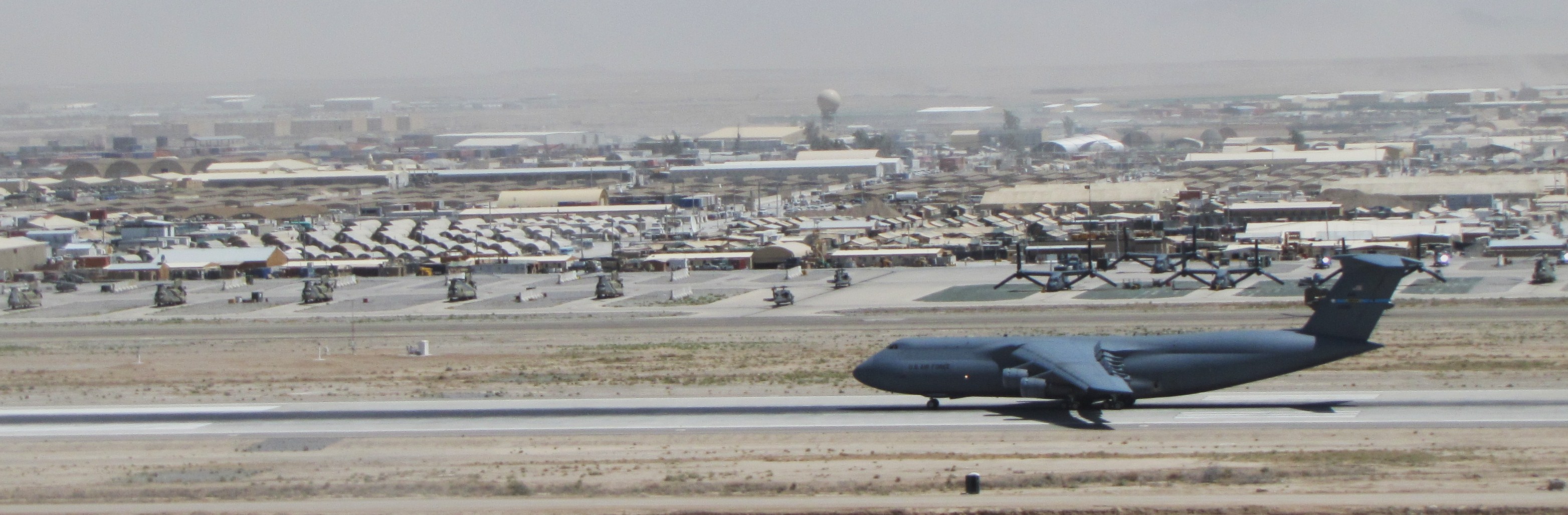
Globemaster Arrival

3. Dust On My Boots

I spent a year in Afghanistan yesterday.

October 2009. It’s 5:00 a.m. Roto 8 had arrived from Canada after 3 days of transit to what seemed to be from all corners of the earth to get to what most would refer to as the dustiest shit-hole on the planet.

I disembarked the Canadian C-17 Globemaster from our layover in Cyprus and shuffled across the tarmac just as the sun was illuminating a beautiful bright yellow across the blue sky. An orange band topped the yellow where the light met the dust suspended in the air. Everything was brown, covered in a thin layer of moon dust. Even the green trees were covered in dust; making them brown. As I marched off the concrete, each step resulted in a small explosion of talcum-like powder that engulfed my pants to mid-shin. I chuckled in disbelief as my new boots already looked like they had ‘time-in’.

After “checking in” to the new resort, my chalk of air-soldiers were ushered through numerous stages of orientation. Since no one had slept in the past 3 days, except for a few winks on an airport floor in ‘secret’ isolation in Germany, most of us were aloof to the detail of material presented. However, coffee and snacks were a welcome provision as we listened to what sounded like Charlie Brown’s teacher professing.

Following this reception, we were ushered through the equipment issue process. Side arms, ammunition, administrative forms and videos on combat first aid techniques were all completed with a focus on the most recent tactical situation to sharpen our purpose.

I retrieved my pistol, a Browning 9 mm sidearm and 30 rounds of ammunition. I loaded it, made it safe and holstered it over my shoulder. Later that night we would go to the ranges to verify they were working. Then like a flock of sleepy sheep, we were herded onto another bus which crawled down a dusty channeled road through the rocket protection barriers and sea-cans.

I arrived at the temporary accommodation called BATs (Big Ass Tents), which would be home for the next two days until the crews of 430 Squadron, who we were replacing, departed so we could take their lodgings. The BAT was a huge white temporary housing haven for soldiers transiting in and out of KAF. It had numerous rows of bunk-beds easily being able to house a company of 150 soldiers.

At the BAT, we were granted a couple hours of personal time. This was very welcome after 3 days of travel before further orientation started in the afternoon. Many flopped on a mattress and immediately slept despite the noisy infantry platoon that had also arrived. Anxious to go home, they were all telling their war stories – adding another realistic dimension to the anxiety of our newly arriving aviation team.

I couldn’t sleep. My mind was nervous about the unknown. So coupled with my body vibrating in sleep deprivation, I could do nothing other than explore. I needed to look around. I clung to a respected colleague who had already completed a tour in KAF several years earlier. He was a fellow Griffon captain and section leader. He was respected for his experience, meticulous work and detailed planning. A person who anyone could look upto for both friendship and advise. However, he had little time for non-sense, which was quite plentiful in a military organization. It wasn’t uncommon for him to look wide-eyed at someone who was presenting a ridiculous comment. And with his head sternly tilted forward and forearm held out across his chest, he would slowly raise his finger-tips pivoting about his elbow, vertically representing and analog meter as he sarcastically warned his conversant:

“My fun-meter is pegged! Conversation over!”

He was proud of this demeanor and often referred to himself as THE grumpy old man. This in itself was contradictory since he was positive and smiled most of the time. However, at one point in our training for Afghanistan, he comically labeled our entire cadre of captains ‘Grumpy Old Men’ depicting the gruff attitudes of our group of senior captains – most of us older than our supervising majors and colonels. Unfortunately, the overwhelming majority of young copilots would have to learn to deal with us for 8 months of pre-training followed by the year in theatre. In order to protect the confidentiality of the not so innocent, I shall refer to him as “Grumpy Old man – Grumpy for short.” (No offense Grumpy)

Grumpy noticed my perplexed look from the realization that we were actually arrived. Conversely, he looked excited to be back and anxious to do some ‘show and tell’.

“You gonna sleep?” he asked.

“Nope.” I responded.

“Timmy’s for coffee?”

OLYMPUS DIGITAL CAMERA
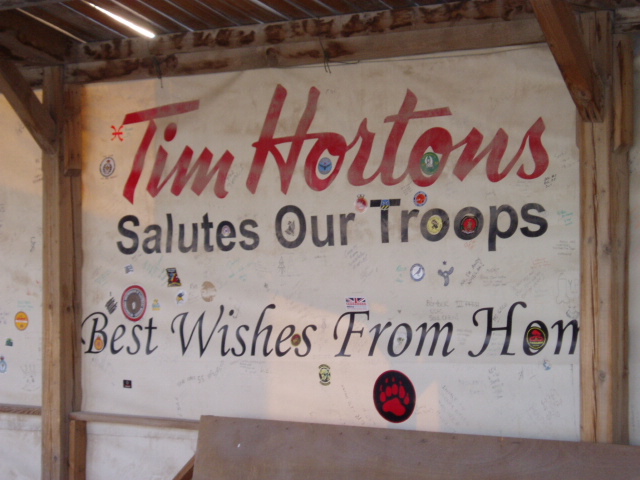
TIM HORTONS ON KAF BOARDWALK 2009

“You bet, I need something to keep me up, I’m sleep-fucked and won’t be sleepin’ with those guys in there tellin’ war stories!” I enthusiastically requested.

Grumpy proceeded down a narrow dusty road walled by sea containers over 5 meters feet high on each side. I was entirely disoriented but he knew exactly where he was in this labyrinth. I surrendered to my curiosity by plodding along in tow. It all looked the same. Shipping containers (sea cans) were piled up row on row making kilometers of a maze-like roadways re-enforced by other tall concrete barriers to prevent rocket attack shrapnel from injuring people. Everything, of course, covered in dust. I followed along watching the little dust-explosions climbing and wrapping around his knees as he pointed to land-marks.

“There’s the TLS again, frontgate, HQ, barber, Canadian gym…” he toured with his arm pointing out landmarks. I was excited to see all these things but figured I need a three kilometer long string to find my way back to the BAT through the all-brown maze.

Tim Hortons was a kilometer away, which was really 2000 dust exploding steps making my shiny, virgin, tan-pattern uniform instantly looking veteran due to the thin film of dessert talcum brown. As vehicles slowly passed by, the intensity of the rising dust forced people to stop until the visibility increased. I coughed out the excess dirt; learning quickly to cover my face by raising my undershirt over my nose. Even after opening my eyes, the sweat from my brow streamed the stinging dirt back into them. I couldn’t escape the talcum powdered invasion. Additionally, combined with damp clothes from immediate heat induced perspiration, the dust clung to my clothing forming a darker brown in those affected areas…it was the typical Kandahar attractive look: dusty brown framed by bacon stripe butt and pit-shadow. Despite only two hours since arrival, my uniform appeared like everyone else’s. The differentiator was the white skin tone and wide, but red, eyes.

The boardwalk was the social centre of KAF. It was a large square with each side about 150 meters in length. The centre courtyard shared a basketball court, a gravel football field, a stage, a memorial rock garden and of course, the Canadian hockey rink. There were market stores and a few cafes offering some psychological reprieve from the ruggedness of the operation. It was comfortable in KAF, especially to those soldiers who lived and worked outside the security fence (outside the wire). To them, this was a resort. Our aviation Battalion aircrew worked outside the wire but lived inside. We understood and respected what the troops lived (and died) through and never tried to take the “resort” feeling for granted. There was already some animosity between soldiers living in the FOBs and soldiers that worked entirely inside the wire. They patrolled every day and night, risking their lives and experiencing pain and death. Yet, everyone serving in Afghanistan was on the same danger pay and received the same campaign medal. Aircrew respected that, and appreciated KAF, but knew that one small bullet in the right place would make us instant foot soldiers outside the wire….that was always in mind. So respect for those living ‘outside the wire’ was never yielded.

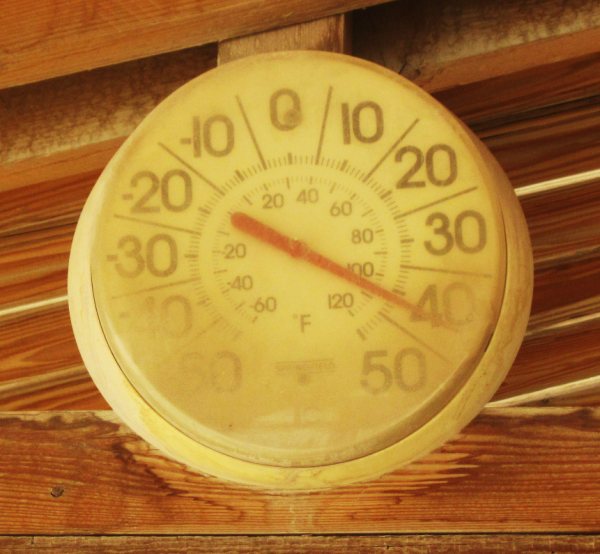
Timmy's temperature
Thermometer in the shade at Tim Hortons.

“Steve, check this out.” Grumpy directed. “You can walk in, or take the walk through.”

“How’s this work?” I inquired looking at two long lines with several dozen people in each.

“If you have a small order, you go in the walk through line. It’s faster. If you want a larger order, go inside”. Grumpy explained. “We’ll stand in the walk-thru outside line. There is a lot to watch from here.”

It took about 10 minutes to serve the 20 people in front but it gave a chance to say hi to various people. It wasn’t uncommon to meet Australians, Russians, Brits and especially Americans who quickly fell in love with Iced Caps and donuts. Newly arriving American soldiers were escorted around KAF by a designated colleague for orientation. Tim’s was part of the tour. I felt unusually proud to overhear them telling their colleagues about how the Timmy’s was a MUST place to go with the best donuts, bagels and Iced Caps.

“Dude, you just gotta say black, which is black. Or regular, which is one cream and sugar. Or double-double which is two of each. They automatically know.” An American with a southern drawl explained to another.

“Oh alright, I got this.” The new comer replied.

“But you gotta order a Wayne Gretzky.” He added.

“What’s that, a hockey player?”

“Ya but it’s a large coffee with 9 creams and 9 sugar. I recommend it highly.” The southern drawl expertly advised.

Grumpy and I both astonished, looked at each other silently repeating in disbelief: “9 and 9?” It was an extreme Tim’s order but nevertheless, I was proud of our national institution in coming to KAF and influencing others from afar to choose Timmy’s over Green Beans, the American choice on the boardwalk.

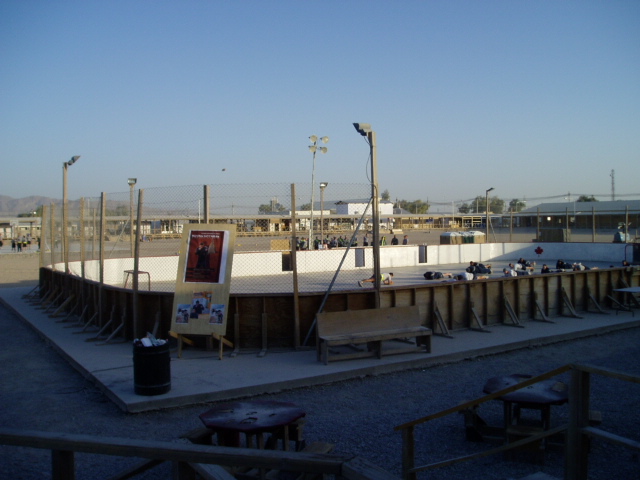
Timmy’s was perched beside a small patio which overlooked the ball hockey rink and also had the best wifi connection. Many soldiers had coffee while concurrently skyping home and watching the game. The hockey games were almost continually on-going — even on hot 40 degree days. Some Canadian night shift workers were currently playing hockey following their shift; soaked in sweat. I noticed the thermometer anchored above the door at Tim’s. It was only 33 on this dusty autumn day. However, it was also only 9 am.

OLYMPUS DIGITAL CAMERA
KAF Hockey Rink – Tim’s patio view

Grumpy Old Man treated me to coffee and we continued walking. 200 meters away was our home to be. We proceeded that direction. He gave me the change from the coffee at Timmy’s, a POG. There were no coins used in theatre, only cash. And instead of coins, a paper POG was given representing 5, 10 and 25 cents. My first souvenir.

The accommodations were beside the American post exchange (like a mini-Walmart) and the Niagara DFAC (dining facility pronounced Dee-Fack). This was where the majority of their meals would be for the next year. It was primarily an American cuisine but had huge variety.

OLYMPUS DIGITAL CAMERA
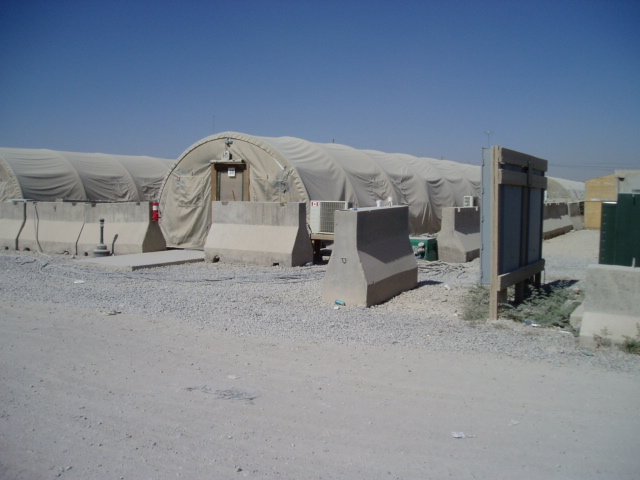
Home Sweet Home for a year.

I entered the small weather haven. A dusty partially torn tent about 60 feet long and 14 feet wide with an arched roof. It would soon be home to 17 pilots. It was dark. It took several minutes to for the eyes to adjust and likewise just the opposite as one returned outside into the bright sunlight. I introduced myself quietly to one of the guys; I recognized him from Canada.Tactical aviation in Canada is a small community. We all cross paths with each other at some point.

In a whispering French accent he excitedly welcomed, “Bonjour! Bien venue KAF! I am glad you ayr haiyr. I keen gow howme now”. He snickered.

“Deese eeze your chamber”. He said. “You can feex it up az you –pray-furr.”

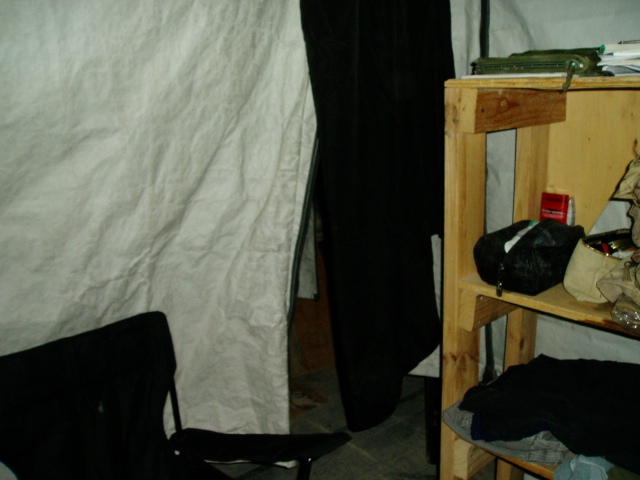
I shook his hand as he directed me to a vacant bed-space. My room was a small 7′ by 7′ square with a sloping roof. It had a bed and some handmade furniture from scrap wood for a desk. It would eventually provide my 6 square feet of living space which I would eventually occupy with a swivel office chair. This took up all remaining floor space. So access to my bed, desk and shelf-dresser had to be gained via the chair. However, it would become home and a sanctuary. It even had cable wired through providing a motivating but not very reliable internet service. Air conditioning seemed to be holding out but we were cautioned not to adjust it or it would fail…this eventually proved as true advice.

OLYMPUS DIGITAL CAMERA
My room from my beds perspective – a little tight.

Since crews were sleeping, as we worked 24/7, Grumpy exited to continue leading the tour. We proceeded to the laundry facility and Grumpy demonstrated the routine. Stand in line, zap strap laundry bag closed with several straps, fill out paper work, keep receipt (or you may never see your clothes again), pass to Afghani laundry clerk, hope you see your laundry in three days.

As we approached the laundry, my eyes began to sting. A penetrating ammonia odour scoured my sinuses making my eyes water. This, in addition to the dust, cause my eyes and nose to go into foreign sensory overload.  I had to take short little breaths to minimize the sharp sting.

“What is that smell?” I asked half covering my face.

Grumpy was smiling. “Next on the tour my friend,” he smirked leading me forward.

Just around the corner was the poo-pond. It was the open pit circular sewage sump that is so large it can be clearly seen on a Google satellite image. It was right behind the laundry. During a westerly wind the entire camp was infused with the sewage stench. It was so strong that it often choked most people and burned the eyes. Unbelievably, I did get used to it. However, there were some days the intensity was overbearing. With a west wind, I had to sleep with my nose covered as the fumes easily penetrated our tents. Grumpy smiled as he showed me the pond; and pointed to the ‘no-swimming’ sign. We both laughed.

We continued touring around, dusty step by dusty step, getting the first kiss of sun burn on our faces as he showed me the other two kitchens, the NATO, American and Canadian gyms as well as the Canadian barber shop and Canadian lines. We finished at the D-FAC for lunch.

All the D-FACS were similar. One stood in a long line to get to the cafeteria style service. Food was usually excellent. Additionally, there was a salad station and an a’ la carte grill to serve primarily American style food: burgers and deep fried. After over-filling my tray to satisfy my starvation from the near 4 day fast, we sat next to a few young American infantry soldiers. The newest was rapidly stuffing his face with what he thought were French-fries while the experienced colleagues smirked and chuckling, hiding the truth. The french-fry eater, twisted his face and slowed his chewing:

“These fries are awful!” he disgustingly reported in his southern accent.

“That’s not fries Bob, that’s whut theys calls cal-i-mari,” his colleagues chuckled.

“Cali-whut?” he responded.

“Squid y’all!” They both broke out in laughter as the novice calamari eater had never been exposed to such flavour and began politely spitting it out; silently dry-heaving in the process.

Grumpy and I chuckled at the entertainment and finished lunch. Satisfied that KAF had not changed very much, he showed me to our next required location. I did not know how we returned to where we started. I was still geographically confused, but a little less disoriented.

That afternoon was filled with more administrative paper work, training and briefings. The entire team was required to walk through a mock-up IED mine-field reviewing safety drills and IED hazards. By this time it was 36 degrees. Wearing fighting gear and helmets gave us a taste of what was to come.

“The first group was getting hammered with instruction. “Stop Stop Stop. IED IED IED.” the sergeant yelled.

“So who’s in charge of everyone in this vehicle? What the hell are you gonna do now? 5 and 20…do it!” We could hear him yelling recurrency instructions expecting immediate action from his trainees. Also adding graphic detail to what would happen if we did not do it right.

“Some of these IEDs have enough explosive power to rip a tank apart!” he taught with enlarged eyes. “Get your shit together ladies and gentlemen.”

OLYMPUS DIGITAL CAMERA
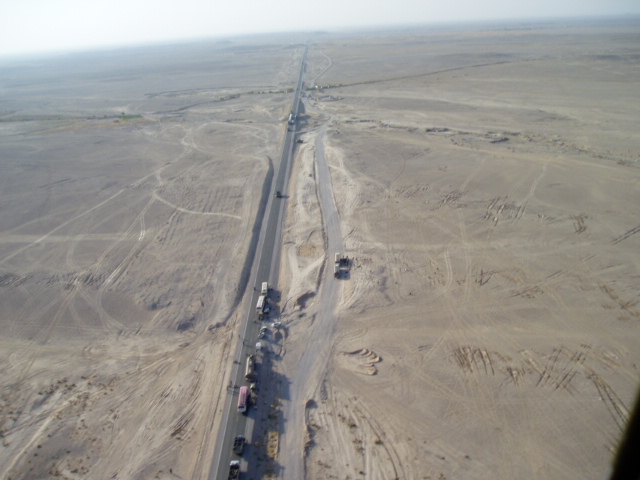
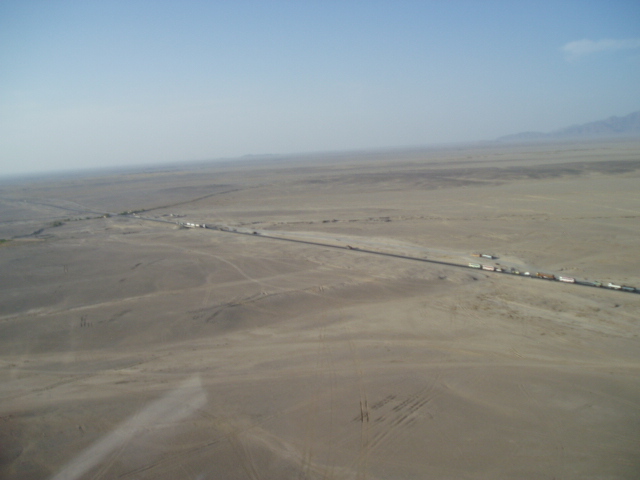
First few days in theatre, Public Highway road halt due to IED – Oct 2009
OLYMPUS DIGITAL CAMERA
Highway One traffic stop due to IED – Oct 2009

This was quick for the our aircrew. We had conducted this training extensively and repeatedly over the past six months. Not only the basics, but also with respect to being shot down and concurrently being in a fire-fight while treating casualties. It’s called combat first aid. And we briefed it daily in our jobs…it was real.

“Roto 8, you are finished for this afternoon. Next timing is busses at the BATs at 19:30. Bring your fighting order to prove your pistols.” A voice bellowed.

At this time, I don’t recall much. I must have slept in the bus and then I think my head hit the pillow for a quick nap. And what seemed like seconds later, someone woke me. It was dark, 19:20 and time to go to the pistol range.

The drive was unique. The rows of 5-meter high stacked sea-cans on either side of the narrow road made it appear like a dust-trof to navigate through. The dust was like a brown fog rising from the vehicles and obscuring vision to only a few feet at times. Since the road was barely two cars wide, the driver proceeded at a walking-pace in order to veer from the on-coming headlights. Despite the heat, the windows remained closed otherwise it would be incapacitating.

We arrived at the pistol ranges. It could have been Tarnac Farm but I don’t recall for sure. It was once outside the outskirts of KAF but was now part of the area. I mention Tarnac because it is significant. In 2002, the first 4 Canadian soldiers were killed here by an American F-16 pilot. The pilot had mistaken them as enemy and attacked them despite attaining PID. It served as a reminder to always have positive identification of the enemy prior to releasing fires. The rule was if any doubt existed, wait for another day. One public speaker briefed us before deployment that the bottom line on pulling the trigger is whether you can personally live with the multitude of results that could occur, not just the obvious result. Appropriately, this affirmation of restraint and patience would come to challenge us on a daily basis. The result lead to many nightmares that some soldiers still have to this day— sorta damned just by being there.

At the range, I stepped off the bus into a another cloud of brown talcum. Dim lights illuminated the 25 meter pistol range at the corners offering just enough light to function. We marched into rows behind 10 targets down range, approximately 5 person deep in each row. This wasn’t about accuracy, it was about proving your weapon worked. A quick 5-round shoot and review of safety drills.

It was an assembly line shoot. A normal indoctrination procedure on arrival. Along with most others, I had now not slept properly in over three days. I was mechanically reacting like a cow in the herd. Brain activity had shut down, it was all muscle memory. Is this safe? What could go wrong?

“First row, at the 10 meter target, on your own time, fire!” commanded the lead gunner sergeant. He was in charge of safety.

Blam blam blam.

“Cease fire, make safe your weapons!” he bellowed.

This required removing the magazine, cocking the weapon as many times as required to clear any remaining bullets, then test firing down range to ensure it clicks but doesn’t fire.

Click – click – click – blam. The gun fired. ….”Oops,” a humble voice embarrassingly called out.

“Number 4 , check fire, is your weapon clear?” boomed the sargeant.

“Well, it is now Sargeant.” was the sleepy reply attempting too, but failing to add levity.

“Number 4 clear your weapon and test fire again!”

Shick-shick, blam. “Fuck!”

The safety Sargent approached the individual and took the firearm.

“You need to remove your fuckin’ mag first soldier!” The Sarge cleared the weapon, test fired – click, and returned it firmly to the candidate with a small shove.

“Against the back wall for remedial drills!” He ordered. “Next line advance!” He continued onto the program without waste.

“With a 5 round magazine – Load!”

And the progression continued. At the end, everyone loaded onto the bus and waited patiently – sleeping – until the remedial training was complete on the four failures.

I’m not too sure what happened next. The bus stopped and robotically each of us staggered into the BAT. I do recall my face falling on a rolled up jacket being a make-shift pillow. I was exhausted and overwhelmed. I never thought I would get to sleep with my mind racing and body buzzing with the huge sleep debt. But obviously I did … until about 2:00 am…

mmmmmmMMMMMMMMRRRRRRRRRRAAAAAAAAAAAAAOOOOOOOOOOOOOWWWWWWWWWRRRRRRRrrrrrrrrr…

mmmmmmMMMMMMMMRRRRRRRRRRAAAAAAAAAAAAAOOOOOOOOOOOOOWWWWWWWWWRRRRRRRrrrrrrrrr…

A deafening siren shook the camp; repeating its oscillating and screaming sound. I sprung out of bed, disoriented. Where was I? What is that noise? I coughed out some dust. Oh ya, it was coming back to me. I covered my ears.

“What the hell is that?” I yelled into the dark.

“Rocket attack!” A voice hollered back.

…And so begins day 2.

The Blogger and Technically challenged.

Hi folks. I thank you very much for the support so far. My font and background colours originally conflicted and burnt a few old eyes out – I think I fixed that. I may have deleted some comments with some post and page management…sorry about that. I think I have the foundation laid now. I appreciate all your posts as well as private messages…and your patience! 😉

Steve “Go For Shakedown”

1. Helicopters In The News – The Manley Report 2008.

         From 2002-2011 Canadian troops were deployed to Kandahar Province. 2002 was shortly after the Taliban Last Stand (TLS) at the airport where the American Forces finally forced out the Taliban government. That building is still know as the TLS building today and remains riddled with bullet impact marks.

Feb 12-13 Chinook and Griffon Moshtaruk
BLOWTORCH and SHAKEDOWN

         The Canadians were brought in to provide the interim government of Afghanistan (GOA) with security forces until the new government could establish, train and equip an Afghan National Army to provide their own security. Canada was given the Kandahar area, Panjwaii District and north up the Arghandhab River to the Dalah Dam. Most to this area had millennia old irrigation systems nurturing a lush beautiful area of fruit orchards, grape fields, and agriculture which was a contrast to the surrounding orangey-brown dessert and brittle rugged mountains. Most of these areas were evenly mixed with opium poppies and marijuana fields – the cash crop and forcefully encouraged by the insurgent forces to finance their efforts against the western nations. This left the grape fields and fruit orchards to die as farmers did not tend to this product. Efforts to take legal produce to local markets were often ambushed, men sometimes being murdered by Taliban. However, the Taliban would go directly to the farmers paying cash for drug crops instead of legitimate crops which was their only option in order to support their families.  This left a role for international forces such as Canada to provide security in the local communities to enable locals to produce legitimate products without insurgent harassment.

         The area was large. The troops were few and often our soldiers became easy targets for IED (improvised explosive devises made from Homemade Explosives (HE)) as they patrolled communities trying to provide security. It was not uncommon to have weekly combat situations – often with injuries. It wasn’t long until our first soldier was returned under a Canadian Flag instead of holding it. When I was serving, it was a daily occurrence to have TICs occurring in the region. (TIC – troops fighting in  contact with the enemy)

         Frustrated yes, but perseverance and commitment continued and the Canadian troops continued in this “wak-a-mole” game of clearing out Taliban from small towns just to have them pour back in after they egressed to a new location.

         Being moved by helicopter was the safer method. However, the Allied Forces were limited in their ability to lend support to the Canadians. It was almost 5 years of being in theatre (OP ATHENA) before the Canadian government released the Manley Report (around 2008). This was the long awaited political justification to increase the Air force by purchasing (leasing) Chinook helicopters to conduct troop and logistical lift to the Forward Operating Bases (FOBs). The aim was to keep soldiers off the vulnerable rural roads. However, there would be the risk of air ambushes. Initially, it was hoped that the American Forces would provide gunship escort to the Chinooks to prevent attacks. However, the Americans had their own forces to protect so the resources to provide escort to Canadians were very limited.

         In 2007/08, the Canadian government was briefed my military seniors that our country was the ONLY country in NATO to NOT have gunship capability to escort our own Chinooks.  Nor could Canada provide armed overwatch (protection) to troops on the ground that come into enemy contact.

         Further to the Manley Report and beyond my knowledge, it was apparent that some decisions were made as the Canadian Forces was quickly converting the CH146 into a platform that could provide such support. In 2008, SHAKEDOWN was born. The Bell 412 EP was converted into a viable combat machine with dual Dillon Cannons and an MX15 electro-optic sensor. The dual M134 Dillons were capable of firing 3000 rounds per minutes. At night with a tracer every 5th round, it looked like a lava waterfall when observing under night vision goggles. The electro optic sensor had a target illuminator that was capable of illuminating areas of interest or targets and identifying them from distances well beyond the sound signature of the aircraft. A few years later a 50 caliber machine gun was also added to the Griffon which enabled the ability to extremely accurately take out targets from a much longer distance.

         In addition to this, the training plan rapidly unfolded to acquire and train pilots, air engineers and gunners for Close Combat Attack techniques, overwatch, aerial escort, surveillance for counter IED operations as well as basic infantry ground fighting skills in the event they were making unplanned stops (shot down) outside the wire.

         At Christmas, 2008 the initial cadre of 6 Chinooks started hauling people and supplies. With them, 8 griffons (4 sections), initially armed with C6 machine guns started providing escort, surveillance and infantry team over-watch. BLOWTORCH was born of the Chinooks, and SHAKEDOWN of the griffons.

         As escort duties became proficient, and experience in theatre built over the next year, combined with the integration of the Dillon M134 cannons with electro-optic sensors, the capability of the Shakedown Flight greatly improved. Higher headquarters realized that door gunnery, which was not available on the Apache or Kiowa Warrior, was ideal for maintaining contact with a target and keeping fire power on that target continuously. This was a benefit over the Apache or Kiowa whose enemies would “squirt” away and hide after the attack helicopters’ initial pass.

         It wasn’t long before the weapon airspace controller’s (‘Slayer’ in the KAF – Panjwaii) favourite resource, when ground troops were in a fight and needed help, became the griffon. “Shakedown, we got a TIC in progress, can you respond?”

         The common and eager response was: “Go for Shakedown”.

http://www.ctvnews.ca/manley-says-afghanistan-report-isn-t-all-bad-news-1.272306